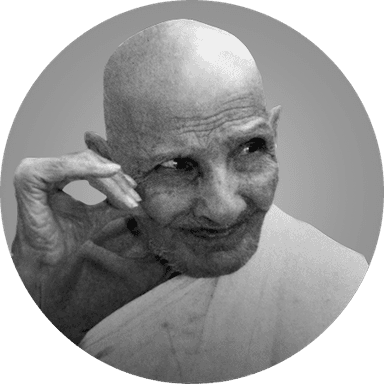
Himanshusuri MS
The Mountain's Hero
1907 — 2002
Ninety-five years. Fifty of them given entirely to Girnar. He performed 11,500 Ayambil, built the Sahasavan temple, and passed away on the mountain itself — the first life that asked the question every guru after has answered.
The Calling
Born on 19 April 1907 in the quiet village of Limbodra, Gujarat — a boy named Hirabhai. No one reading the circumstances of his birth could have predicted what would follow.
He took the vows of diksha in his early years and in time found his way to Girnar. What he found there was not simply a sacred mountain. It was an unfinished offering — temples in disrepair, steps overgrown, a pilgrimage that should have pulsed with life fading quietly into neglect.
He did not leave. He stayed. And gave the remaining decades of his life to restoring what time had forgotten.
The Practice
Eleven thousand five hundred Ayambil fasts. More than three thousand additional fasts across a lifetime. The numbers read like statistics until you understand what they mean: years upon years of austerity, day after day of refusing the comfort the body asks for, so that something deeper than the body might be fed.
He also built. Most notably the Sahasavan Samavasaran Temple — raised between 1981 and 1985 at the very summit of the sacred grove where Neminath himself received his diksha and kevalgyan. Four years to construct. A structure that stands today as the living crown of Girnar.
The austerity and the construction were the same act. Both were the practice of giving everything — and then finding there was still more to give.
The Teaching
His teaching was not written in books. It was written in stone. In restored temples. In a pilgrimage route that became, under his care, not just walkable but sacred again.
To those who spent time near him — and Dharmarakshit Suri came and gave four years — the teaching was the simplest possible lesson, which is always somehow the hardest to absorb: there is no substitute for showing up. Day after day, year after year, decade after decade. Without assurance that it will matter. Because it will.
Devotion, he showed, is not always a sermon. Sometimes it is a stone placed carefully on another stone, eleven thousand times, for fifty years, until the mountain holds what it was always meant to hold.
The Legacy
He passed away on 18 December 2002, at the age of ninety-five — on Girnar itself. And when his final rites were performed at Sahasavan, it broke a tradition held for five hundred years. That exception — the mountain receiving him in death as it had received him in life — was perhaps the most eloquent testament to what he had been.
A foundation is invisible by design. You walk on it without noticing — because if you noticed it, the building above could not stand. Three gurus have come after him. Each standing on what he laid. Each carrying what he started.
This is the deepest kind of legacy. Not the legacy that bears your name. The legacy that bears the next generation's weight.
The Invitation
He does not ask you to fast eleven thousand times or build a temple on a mountain. He asks something more personal than either.
He asks: when you find the unfinished thing that is yours — the thing that no one else will do, the thing that asks everything of you — will you stay?
His answer, lived across ninety-five years, ending on the mountain itself on a December morning in 2002, was simply and completely: yes.
Himanshusuri is one of four. The lineage continues. Where next?